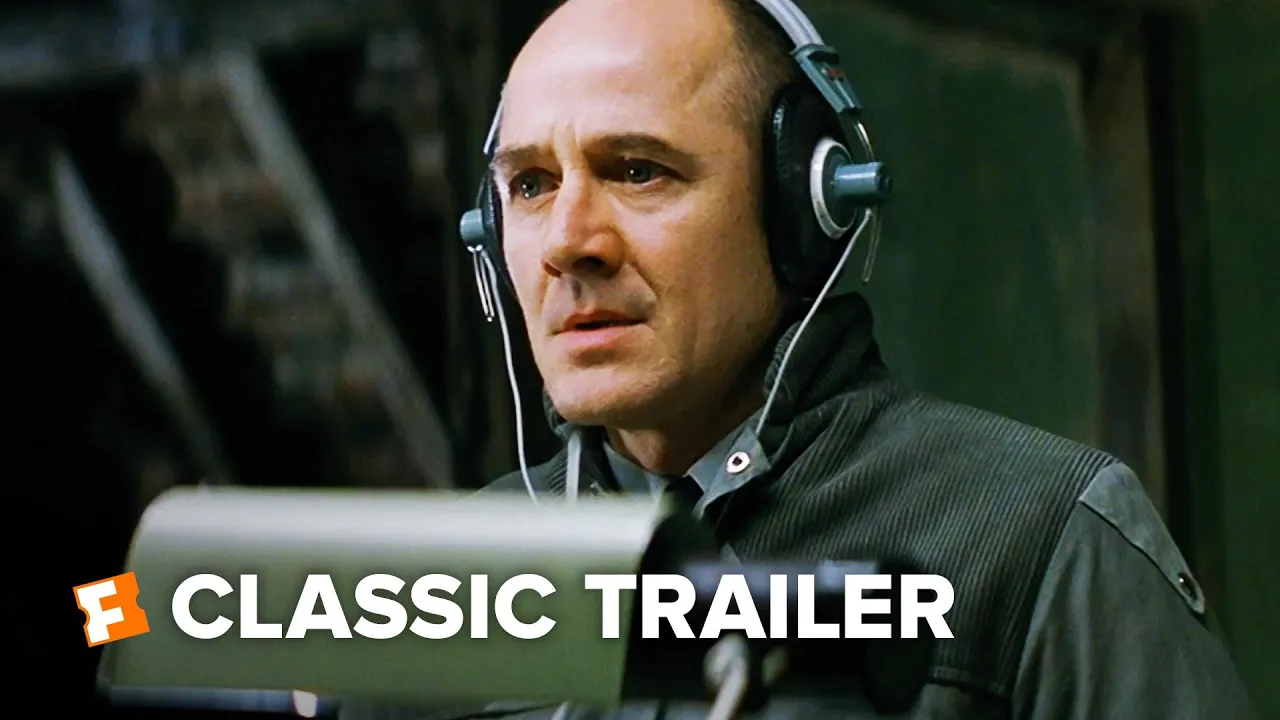
Cinema : The Lives of Others ( 2006 )
Cinema : The Lives of Others ( 2006 )


This is one of my favourite films. Like Good Bye, Lenin!, it is one I return to whenever I have some free time. I first came across it in You the Freedom by the Chinese writer Xiong Peiyun. By coincidence, I had already spent a long time before that studying totalitarian rule in the Soviet era, from the Great Purge to the long years of repression that followed, so when I finally watched it, it resonated with me very strongly.
For me, the most compelling part of the film is the transformation of its protagonist, Wiesler. At the beginning, lecturing his students as a Stasi instructor, he is the very image of the professional bureaucrat inside the system. Then comes the shock, and the first wavering, when he discovers that Minister Hempf, a superior who is supposed to believe in the Party and serve it loyally, can simply use Dreyman's partner however he pleases. From here Wiesler begins, slowly, to sympathise with Dreyman. He steals one of Dreyman's books and lies on his sofa reading it with quiet pleasure. When a child in the lift says something politically careless, he lets it pass, and asks him instead what his ball is called. When he hears of Jerska's death and listens to Dreyman play Sonata for a Good Man, he is moved to tears, and the decision is finally made: he will help them. And when Dreyman's partner comes close to betraying him by revealing where the typewriter is hidden, Wiesler has already moved it. It is a transformation from a surveillance agent bound to a totalitarian machine into a first, faint glimmer of humanity. Throughout all of this, Wiesler and Dreyman never once speak, and never once meet. Only at the very end do their magnetic fields touch, from a distance.
In reality, the fear people lived with in communist countries at that time, and the methods their rulers used to keep it alive, were remarkably alike. In East Germany, the Gestapo had simply given way to the Stasi; in Czechoslovakia, Hungary, Poland, Albania, Belarus and Cuba, the same thing took the form of different regional secret police. They watched people's thoughts, their every word and every movement. They encouraged families to inform on one another, stripped away people's most basic goodness and sincerity, and tied right and wrong to loyalty to the Party. And the power to decide what those standards meant had merely changed hands, as Animal Farm shows, from the humans to the pigs.
Yet I have heard that within the real Stasi there were almost no Wieslers, almost no one who kept even a faint afterglow of humanity. And at the end of the film, the superior responsible for so much harm remains exactly where he was. He can even stand before Dreyman and lament the death of his partner, while Dreyman can only swallow everything that his friends and loved ones suffered over those years. The ending of the Chinese film Hibiscus Town, set during the Cultural Revolution, holds something very similar. The two protagonists have their family torn apart, and the husband is wrongly imprisoned for ten years, yet the official who led the revolutionary denunciations keeps her position securely, because her father is a county magistrate.
Two years ago, I finally set foot in the Federal Republic of Germany. For the first time I saw with my own eyes the wall that had once divided two worlds, East and West, and in the Stasi Museum and the DDR Museum I saw the pain and the memories that era left behind. After the Wall came down, did Wiesler and Dreyman ever look back, and think about how absurd that whole era had been?

